
Hit It Impact Play - a SHAG Mini-Workshop - PART 2
November 10, 2022
Hit It Impact Play - a SHAG Mini-Workshop - PART 2
Hosted by Artemis
Watch on IG @weloveshag
YouTube @weloveshag
If you haven’t checked out part 1 of this workshop, read the transcript here!
A very cool thing about impact play, which is true with a lot of kink, is that it inherently is de-gendered. It is inherently available to all people and bodies. This is very different than “vanilla” sex, which carries so many assumed abilities that might make it difficult, uncomfortable, or unavailable to some people. Impact can be a really interesting thing to explore if you have chronic pain, if you are experiencing any of the plethora of medical or psychological conditions that make “vanilla” sex – what we are taught in school with the banana and the condom – unavailable to you. Impact and kink, in general, can provide fantastic ways to connect with a partner, connect with yourself, or connect to your own body, in ways that are not so tangled up in socially fraught ideas about what sex is supposed to look like or be like. You can still have a beautiful catharsis, intimacy, and trust: all the things that make for good sex.
Please consider this word of caution against going to the kitchen for impact toys! It may be tempting, but there are purpose-built things for play that are safer, work better, and are beautifully designed. We live an amazing time! At SHAG we sell all kinds of goodies, at all kinds of price points, which are built especially for impact fun. Using impact-specific toys reduces risk considerably. While there are many DIY approaches to creating impact tools, please approach them with caution. Consider buying a tool that's made to hit someone, which will make it much easier to have fun safely. That said, there is one very safe and accessible DIY option! It also happens to be the best way for beginners to try impact play! This impact tool is one that most of us already have! In fact, we usually have two of them. That’s right: our hands! We are equipped incredibly with two fantastic implements for impact. In any impact scene, or exploration of impact as an interest, using your hands is a great place to start. Hands are actually quite versatile. There are many different ways that we can engage with our partner using our hands.
Using your hands also helps you gain better knowledge of an important safety component to impact play, which you will need in order to safely use any other impact tools. That is placement. Where you are hitting people is an incredibly important ingredient in all this. I'm going to call upon my assistant, Erin, our impact model today. Erin is also my partner of eight years, which means we have a high level of existing communication between us. We've gone through this scene, we talked beforehand, and we know each other extensively, which means we are not necessarily modeling the levels of conversation and consent you might want to have. Instead we are demonstrating the act of impact itself.
You don't have to hit people on the back of their bodies, but that is, generally speaking, the most likely set-up. Therefore today we are going to start with a common area of interest: the beautiful human rump. With impact, we mostly want to be hitting fleshy, soft areas, and the butt is a great example of that. We do not ever want to hit bones! Not only is impact to our bones not fun, it is very dangerous. On each of our bodies, there's this beautiful ridge where our pelvis is. Do not land your impact there when aiming for the butt. Do not hit weird bony places. Other important areas on the body to avoid include the fronts of the knees, the backs of the elbows, the front of the chin (ouch!), and anywhere where there are bones visibly protruding. Think of accidentally hitting your chin on a coffee table. It is not sexy. Our spines are not just bony but delicate; a lot of crucial information is being passed up and down here. Do not hit your partner on the spine! You want to look for fleshy, meaty parts of the body. During impact, always, the partner giving impact is in constant conversation with the person that is receiving. Feedback is important: “Oh, that didn't feel so good,” or “That's actually fine. More please.”
During your impact play, please remember that there is no rush! Everything we talk about today can be explored slowly to see what feels good and is interesting for everyone involved. There are some body parts that aren’t quite bony or fleshy: for example, the shoulder blades, when not protruding, will have the protection of the flesh of the human back, and you can therefore explore impact there a little bit. Going slowly means judging not just how something feels but which implement to use for the right mix of sensation and safety. Using hands as impact tools, it's pretty okay on most bodies to hit the shoulder blades as long as you make sure to avoid the spine and pelvic crest. Especially important is avoiding the kidneys! Do not ever hit a kidney, especially with tools like floggers or paddlers, or anything that uses blunt force. Blunt force to the kidneys would mean a visit to the doctor. Also important is to avoid hitting someone from above. Although very common, that is also really dangerous. As a top, stay below your partner. Try to find their tailbone, and then stay below that. One advantage to this strategy is that you have better access to the safest and most fun places for impact! Under the butt is all fair game. On the backs of the legs, we have the sciatic nerve. You thought this was a sexy lesson? It’s science class! Joke’s on you. We're going to be doing some physics later. Maybe some chemistry. Not really, of course.
Because of the sciatic nerve, some people love impact on the back of the thigh. For some people, it's a very strong, fantastic sensation. But do keep in mind that you can aggravate that nerve, which is why it is important to aim for layers of communication, ongoingly and throughout the scene. One exception to the “below the butt is fair game” rule is the backs of the knees. Because there are lymph nodes and other sensitive bits there, do not hit behind the knee! Moving down the leg, do not forget the feet! The soles of the feet are a spot that people don't usually think about, but it’s an area that's very ready for impact with consent and conversation. Moving on to the front of the body, the fronts of the thighs are ok for impact. Please take note that aiming for soft, flesh body parts does not mean impact to the organs is okay! Avoid hitting your partner on the belly or ribs. You don’t want to hurt the diaphragm. Breasts can be smacked – with caution! Do not aim your impact to the breasts towards the body though; shearing force is a better idea. You do have to be careful around the groin genitals, though. That play is part of a different type of scene, one that this workshop is not about. If you want to get into that: mazel tov, but you’re going to need a lot more research to stay safe in your play!
The hands themselves can be used to hit your partner, as we have covered, but they can also be used to feel and check in as you go. In general, it is common and good advice to warm up before continuing with your scene. You can use your hands to literally feel the skin becoming warmer to the touch. Or, if you want to use impact as a little seasoning on another sexual activity, you might not warm up, per se, but you will still want to start slow. Do not run in with guns blazing! Doing that can make communication difficult, but it also gives you nowhere to go, and ultimately limits the duration and intensity your scene might attain. A good goal is to start so soft that the partner who is the bottom might be thinking “Is that it?” The warm up is what allows both partners to become deeply involved in the play. A really hard, intense hit first thing can be a red flag, signaling that the top is inexperienced or that both partners need more communication to safely continue. The threshold at which an impact sensation is too much is both very subjective and very subject to change, as long as you go slowly and methodically along the way to increased intensity.
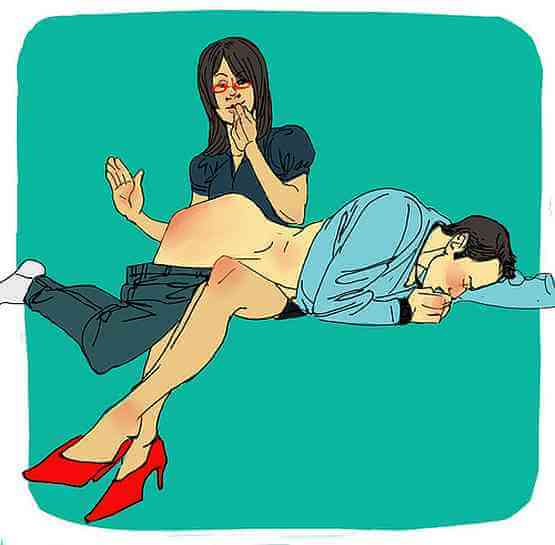
The way you use your hand can be a part of escalating intensity. You can use your hand closed, fingers squeezed side by side (like you are swearing to tell the truth, the whole truth, and nothing but the truth, not like you are in a fist fight), or you can use your hand open, fingers spread. The difference is a bit like the difference between using a paddle that is solid or a paddle with holes. I call them speed holes. A paddle with holes is like an open hand, and a paddle with no holes is like a closed hand. The difference, and this is the physics part of our science lesson, is that when we hit someone with a flat, solid surface, there is actually a cushion of air that softens the blow. Flat, unbroken surfaces creates little cushions of air on impact, which make for thuddy rather than stingy sensations. If your instrument has holes, on the other hand, there is no cushion of air, which means faster full contact between the impact tool (or hand) and the area of the body receiving the impact. That faster contact feels like more of a sting than a thud. The thud to sting continuum is a very useful one to keep in mind when it comes to evaluating any implement or toys. Thuddy to stingy is a spectrum that helps folx categorize and communicate some of the common sensation experiences as a bottom. When it comes to the hands, you can also make a fist if you want to be really, really thuddy, but that will create deep purple bruises, as opposed to more of a redness on the skin. Ideally, you want to start your impact play with your hands, increasing intensity until the bottom (or other area of skin) feels warm or hot to the touch. It should feel like your bottom has a fever. This heat should be perceptible by touch before you progress to other tools.
**This text was transcribed from SHAG’s live Mini-Workshop on November 10, 2022 and edited for clarity. This opinion piece is not intended to constitute licensed expert advice; all content is for general informational purposes only.**

Comments